Showing posts with label emotion. Show all posts

Thursday, July 23, 2009

Self-tracking through Twitter

Data data data. Especially, our own.

From Nike shoes that allow you to log your miles on an iPhone app, to that kid on Twitter who feels compelled to tell the world how many laps he swam each morning, self-monitoring seems to be the latest fad. I track, therefore I am.

And while there is no shortage of tools available to our inner OCD, one in particular stands out in my mind: your.flowingdata.

Created by UCLA PhD candidate Nathan Yau as part of his thesis on self-surveillance, your.flowingdata allows users to aggregate personal data through daily tweets, and then visualize it in various different formats, including graphs, treemaps and word clouds.
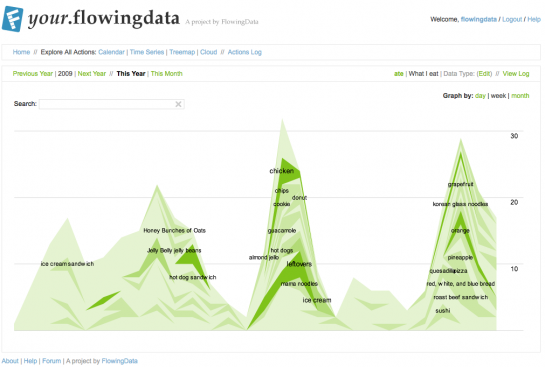

Obviously, as a closet obsessive-compulsive and data visualization fan, I am more than a little intrigued so I've started tracking one simple aspect of my life: my moods and their intensity during the workday (since that's when I'm mostly on Twitter).

Yes, I realize I have picked perhaps the least objective metric possible, but that's half the fun. I'm curious as much about my moods as to what might affect my perception of and decision to report on them.

More updates on that to come.

In the meantime, you can read more about your.flowingdata here.
Also, here's an older post on visualizing music consumption, another cool thing to track.

Sunday, May 3, 2009

Smile! Your future marriage might benefit!


A recent study, excerpted in The Economist, draws a possible connection between high school yearbook photos and divorce rates. As it turns out, the less people smile in their yearbook photos, the more likely they are to divorce later in life.

So... happy kids end up in happy marriages?

Or, considering the misery of high school for so many of us, is grinning for the camera just an indicator of one's ability to smile through the pain?

I am in a cynical mood today.

Thursday, March 5, 2009

Robots, Love, Babies


Kenji, a third-generation humanoid robot, was originally programmed to emulate the human emotion of love, but ended up emulating dependence and fear of abandonment instead.

"After some limited environmental conditioning, Kenji first demonstrated love by bonding with a a stuffed doll in his enclosure, which he would embrace for hours at a time... Researchers attributed this behavior to his programmed qualities of devotion and empathy and called the experiment a success.

...

"The trouble all started when a young female intern began to spend several hours each day with Kenji, testing his systems and loading new software routines. When it came time to leave one evening, however, Kenji refused to let her out of his lab enclosure and used his bulky mechanical body to block her exit and hug her repeatedly."

Nope, looks like Kenji wasn't displaying devotion and empathy at all.

Interestingly, his behavior is surprisingly similar to the first steps of social-emotional development in babies. At around 8-10 months, babies begin to show signs of human attachment, mostly in the form of separation anxiety, and only later do they acquire the capacity of empathy and an understanding of social rules.

So maybe Kenji just needs to grow up?

The story gets funnier:

"The intern was only able to escape after she had frantically phoned two senior staff members to come and temporarily de-activate Kenji."

Would have loved to see that. You can read more about Kenji here.

Tuesday, February 17, 2009

The Spotless Mind


Believe it or not, Dutch scientists have conducted a research study suggesting that a common heart medicine, beta-blockers, might actually help people banish painful memories.

The researchers induced negative memories on a group of subjects by exposing them to images of spiders accompanied by mild electric shocks. The next day half of the subjects were given a dose of beta-blockers while the others received a placebo pill. When exposed once again to the same spider-shock combo, those subjects who had taken the beta-blockers showed less fear than the control group, even after the effects of the meds had worn off.

They had not forgotten the spiders or electric shocks of the previous day, but somehow the negative aspects of their memories had diminished.

How is this possible? One hypothesis rests on the intricate process by which we recall memories:
"Each time a memory is recalled it changes a little, and the new version is recorded in the long-term memory stash via brain chemical fluctuations in a process called reconsolidation. The beta-blockers could interfere with [certain other] brain chemicals, blocking reconsolidation of the emotional component of the memory, but leaving the rest of the memory intact."
So, in a sense, no memory is truly being erased -- though sensationalism sells, as do parallels to Gondry movies starring Kate Winslet. But then again, what's left when we erase the content of our memories? A bunch of empty facts that, stripped of their emotional relevance, will likely be truly forgotten soon after.

For more on these experiments, check out these articles from BBC News and Discovery Magazine.