Showing posts with label science. Show all posts

Tuesday, November 3, 2009

The breathing earth

This is really fascinating -- and sobering. A real-time simulation of CO2 emissions by country called The Breathing Earth. And yes, the picture it paints is pretty dire.


Worth checking out!
The Breathing Earth

Wednesday, August 19, 2009

Visualizing your online persona

Ever been curious about your online identity? Or, more specifically, how a computer algorithm with all its inherent limitations might perceive your online identity?

Enter Personas, a project by the Social Media Group from the MIT Media Lab:
"[Personas] uses sophisticated natural language processing and the Internet to create a data portrait of one's aggregated online identity. In short, Personas shows you how the Internet sees you.

"Enter your name, and Personas scours the web for information and attempts to characterize the person - to fit them to a predetermined set of categories that an algorithmic process created from a massive corpus of data. The computational process is visualized with each stage of the analysis, finally resulting in the presentation of a seemingly authoritative personal profile."

Okay, so this doesn't work for me because I am a virtual unknown with no online identity to speak of. I am an Internet Nobody, sad but true.

But I tested this out instead with one of my favorite Internet Somebodies: Richard Feynman (full disclosure: he was my longest lasting imaginary crush through high school). The results are quite funny...


Click the image to enlarge (sorry for the low res).

I have to say, I would never guess this was the online persona for a Nobel Prize winning physicist... The big sports component (yellow on the left) is to me most amusing. Run the algorithm and you'll see that it's due to a misinterpretation of the words "series" (in this case "lecture series" not sports series) and "player" (from the oft-reported fact that Feynman was a "bongo player" - really).

Of course, the smart kids at MIT were aware of this all along:
"Personas demonstrates the computer's uncanny insights and its inadvertent errors, such as the mischaracterizations caused by the inability to separate data from multiple owners of the same name. It is meant for the viewer to reflect on our current and future world, where digital histories are as important if not more important than oral histories, and computational methods of condensing our digital traces are opaque and socially ignorant."

Nifty stuff.

Tuesday, August 18, 2009

Rorschach paintings: From ink to art

Vesna Jovanovic is perhaps not your typical artist, and her works are most certainly not typical. Once an arts and chemistry double-major, she now draws inspiration for her paintings from nature, science and psychology.

Her most recent works? A series called "Pareidolia," in which she starts with a random ink spill, and then fills in the silhouette with meticulous drawings ranging from the organic to the mechanical: veins and neurons interlaced with glass-work and electronic wiring.


The title itself is genius:
"I eventually titled the series Pareidolia, a term used to describe the psychological phenomenon of recognizing specific, identifiable forms in otherwise random stimuli. Common examples of pareidolia are the recognition of animals in clouds or faces in wood grain, and it is the basis of the Rorschach test, the series of inkblots used by psychologists to gain insight into a patient’s mental state."

Indeed, the creative process itself works like an applied Rorschach test, turning an inkblot and its connotations for the artist into a work art.

Check out Jovanovic's portfolio here.
Via Seed Magazine.

Saturday, June 6, 2009

Of money and morality


A little while ago I posted about site called YourMorals.org, which uses responses to various quizzes as data for research on moral psychology, and since then I've been taking a bunch of their tests.

This has afforded me such encouraging insights as: I am significantly less satisfied with my life than the average test-taker, I am more likely than average to react to things with disgust, my morality is essentially about avoiding harm and preserving freedom, and I take serious issue against authority and purity. Go figure.

But there's one test in particular that caused me to pause: the "Sacredness Survey".

It works like this:
You are presented with various hypothetical acts (burning your country's flag, pricking a child's hand...) that might violate notions you hold "sacred" and you are asked what it would take for you to engage in these acts. Your response options are the following:
  • $0 (I'd do it for free)
  • $10
  • $100
  • $1,000
  • $10,000
  • $100,000
  • A million dollars
  • Never for any amount of money

So, at risk of revealing myself as the freak that I am, here were my results -- and it should be noted that this applies only to the acts that I said I would do: it excludes things I wouldn't do for any sum of money.
  • It would take an average of $0 to get you to violate the HARM foundation.
  • It would take an average of $5000 to get you to violate the FAIRNESS foundation.
  • It would take an average of $33333.333333333 to get you to violate the INGROUP foundation.
  • It would take an average of $0 to get you to violate the AUTHORITY foundation.
  • It would take an average of $0 to get you to violate the PURITY foundation.

Creepy right? I sound like a cheap psychopath.

But this is where I think the study is flawed, or at least very ill-suited to my personal brand of morality...

When it comes to morality and "sacredness", if there's something that doesn't bother me, then I need no financial compensation to do it. In fact, I will gladly break a taboo just for laughs.

One that tickled me from the survey: Sign a piece of paper that says "I hereby sell my soul, after my death, to whoever has this piece of paper." Sure, I'll do that for free for the sheer irony of it.

However, when it comes to things I won't do, like pricking a child's hand (back to my harm-based personal morality), then typically no amount of money will convince me to do it, not because I'm so honest I can't be bought, but because getting paid for doing something bad makes it worse, not better. I may regret harming a child, but getting paid to harm a child is something I might never be able to live down. And the greater the fee the more immoral the act.

Who knows... I guess it's my relationship with money that's coming into play. I have no problem getting paid for work done or services rendered (heck, I have a job after all!), but getting paid to do something bad is a whole other story. So basically, I think my personal financial hang-ups are creating "noise" in my responses to that survey, confusing the results.

I my mind, the major flaw with this survey is that is assumes a commensurability between money and morality, as if the costs of one could be compensated by the benefits of the other. However, money itself has huge moral connotations for most people and it's wrong to think one could introduce that into the equation without fundamentally changing the game.

Tuesday, June 2, 2009

Quizzes for a cause

Ever been curious about the fundamental underpinnings of your personal moral code? Or how you stack up against others in the moral spectrum? Or how morality affects your daily behaviors?

Take the quizzes offered on YourMorals.org and your answers will be added to the body of knowledge informing current research on moral psychology.

Plus, the tests are wonderfully addictive.

Tuesday, May 19, 2009

The world in miniature

Okay, bear with me here, because when I first saw this, I thought it was about how to take photographs of miniature model landscapes - something I'd much rather leave to the more arts-and-crafty among us. But that's not what this is about.

This is about taking an ordinary photo, say of a real city or landscape, and making it look like it's depicting miniature models. Like the photo below... Toy boats on a miniature lake, right?


Nope, it's actually just a doctored image of a real life coastal landscape.

Trivial? Useless? Maybe, but check out how it's done.

TiltShiftMaker
is a site that does just that, and it does it very simply, by just reducing the depth of field of the photo: the portion of the photo that looks sharp and in-focus. Turns out, the shallower the depth of field, the smaller and closer the objects in a photo look, to the point of making real landscapes and buildings look like nothing more than miniature models.

The reason this works is that when we look at something small and close to our eyes, the portion of our field of vision that is in focus is very small. Conversely when we look at something very large and far away, the potion that is in focus is actually much greater. So when we notice a shallow depth of field, regardless of what we're really looking at, our brain signals SMALL and CLOSE (rather than BIG and FAR) and we use this to make a determination as to what we might be looking at - for example, tiny model boats as opposed to a life-size coastal landscape.

What fascinates me about this is that we do this entirely unconsciously. I didn't know anything about photography or depths of field before looking into this -- in fact I had to wiki depth of field to make sure I was talking about the right concept. But on some level, my brain did know. It's just one thing among a huge quantity of information that we unconsciously process in order to make deductions about the world around us from what is essentially a pretty limited set of sensory perceptions.

Here's other related example - it's a pretty common optical illusion.
Look at the image below... Concave or convex?


To virtually everyone the left side looks like buttons, while the right side looks like shallow holes. The interesting question, however, is why.

The answer is that we make the determination based on how the disks are shaded, interpreting the colors as light and shadow. If there is one thing we know intuitively (though perhaps not fully consciously) about light is that it tends to come from above - from the sun or from lamps. So a disk that is lighter on top we interpret as a protruding button catching light from above, whereas a disk that is darker on top we interpret as a hole shaded from above and catching light on the bottom.

In a way our minds are incredibly ingenious at noticing patterns in our perceptions and using them as clues to navigate the world around us, basically making educated guesses along the way.

But know enough about how the mind works, and you can easily trick it!

Via Apartment Therapy.

Wednesday, May 13, 2009

United Sins of America

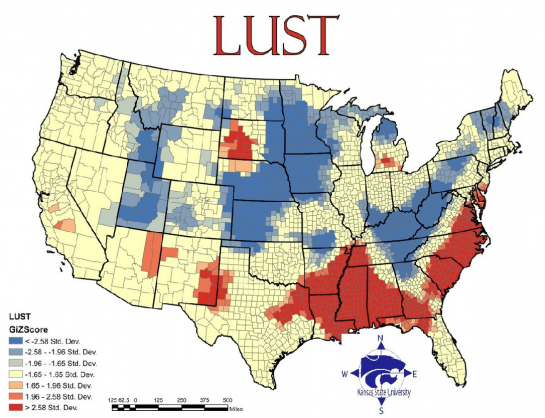
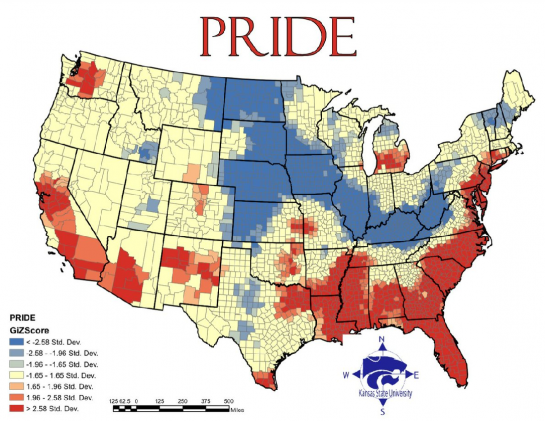
Theoretically interesting, but sketchy in its execution: geographers from Kansas State University create visual maps of the prevalence of the seven deadly sins across the U.S. using various statistics as a (tenuous) proxy for the country's sinfulness.


Lust: based on the incidence of sexually transmitted diseases. Because lusty people have unsafe sex and spread disease. Research courtesy of the Bible Belt!


Gluttony: based on the number of fast food restaurants per capita... While I definitely get the correlation between gluttony and fast food (big, cheap and FAST!), perhaps an obesity map would have worked better? All this shows to me is the homogeneity with which fast food franchises have colonized the country.


Greed: reflects average incomes versus total inhabitants below the poverty line... This one I believe is flawed. I can't think of a way of combining these two statistics to come up with a measure that would at all correlate to or even connote greed. The map too seems to indicate that they are simply equating greed with prosperity.


Sloth: reflects spending on arts, entertainment and recreation versus rate of employment... A bit uninspired, and ideologically flawed, but okay.


Wrath: reflects total violent crimes per capita. Sounds about right!


Envy: based on the total number of thefts... Seriously? San Francisco guiltier of envy than LA???


Pride: calculated as the average of the six other sins... because pride is the origin of all sins? Cop out.


So... I take it Heaven is full of mid-westerners.

Via Flowing Data and Revolutions.

Tuesday, May 12, 2009

A world inside a book

Brian Dettmer is an American artist, mostly known for his works involving alterations of existing media: books, maps, records, audio casettes...

Among his most fascinating pieces are his book carvings, turning ordinary books into sculptures and revealing their content as a three-dimensional work of art.

This one is entitled Science in the Twentieth Century.


Check out more of Dettmer's works on Flickr.

Found through Centripetal Notion.

Monday, May 11, 2009

Mad science?


While many people's reaction to this is likely to be outrage at the money we're wasting, In This Economy, researching pipe-dream theories... this is actually the sort of thing I love.

Wired Magazine outlines six of the most out-there fields being studied today.

My three favorites?
  1. Precognition (Daryl Bem, Professor Emeritus of Psychology, Cornell University)
  2. Disembodied Consciousness (Edward Kelly, Research Professor of Psychiatry and Neurobehavioral Sciences, University of Virginia)
  3. Telekinesis (Garret Moddel, Professor of Electrical, Computer and Energy Engineering, University of Colorado at Boulder)
Seriously, if there's a future out there where these notions become reality, sign me up!

Check out the article here.

Monday, April 20, 2009

Hearing sights, seeing music

I wish I had synesthesia!

It's a neurological "condition" (minus the negative connotations), affecting about 4% of the population, in which cognitive and sensory pathways "cross over" one another, leading to an unusual "blending" of perceptions.

Sight gets mixed in with hearing, hearing with taste and so on... One might experience blue as not just a color, but also as a taste; or the sound of a cello as inherently "green", not simply as a metaphor, but because the visual experience of "green" accompanies the auditory experience of the sound in a very real and literal way.

It's fascinating stuff and truly makes one wonder about the possible differences among people's perception of the world.

So if this has sparked your interest, here are two interesting articles on synesthesia:

In this interview, neuroscientist David Eagleman talks about the synesthesia gene and the The Synesthesia Battery, a free online test for synesthesia aimed at promoting scientific progress in the field.

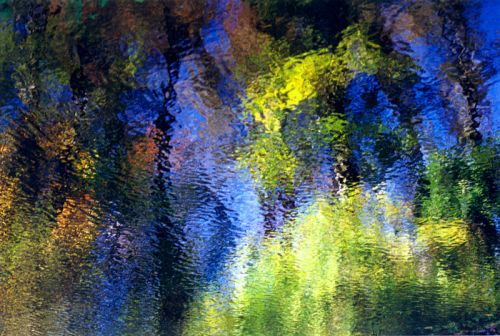
Even more fascinating: consider synesthesia from the perspective of art. Artist and synesthete Marcia Smilack creates photographs and videos to recreate some of her visual-auditory sensations for non-synesthetes. You can read about her in this Seed Magazine article, The Most Beautiful Painting You've Ever Heard.

Also, check out Smilack's portfolio here.

Thursday, April 16, 2009

Sleep: simplifying synapses?


A recent study seems to support the controversial theory that sleep preserves brain function by weakening or even severing connections between brain cells.

Counter-intuitive, at the very least.

Scientist theorize that this weakening in synapses serves to "save resources ... and boost the signal of important memories over the noise of unneeded connections." It basically clears up the brain for new thoughts and memories.

The findings are by no means certain - indeed there have been past studies suggesting the precise opposite: that sleep strengthens rather than weakens synapses. However, it's still and interesting thought.

It also echoes a similar and equally surprising finding in urban planning: that removing roads and traffic lights actually speeds up traffic. Whether you buy into the roads/synapses analogy, it's a fun article to read: touching upon all sorts of topics from mathematics to economics to game theory.

For more on sleep and synapses, check out this digest on Discover Magazine's blog.

Monday, April 13, 2009

Trauma and the spotless mind


Seems like selective memory deletion is really the hot topic of debate nowadays, and obviously I am fascinated. This recent article, on Wired Magazine, touches upon the possibility of using memory editing drugs to treat post-traumatic stress disorders (PTSD) in soldiers.

The moral and ethical issues related to memory-editing drugs of course are numerous, and I've touched on a few of them before. My question here is a more practical/functional one...

On a very simplistic level, the case for using memory deletion to treat PTSD is that absent the negative memories from which they originate, the stress symptoms will subside. However, I wonder if there are cases in which knowing and dealing with the source of one's anxiety might in fact be the best way to cure it... Exposure therapy, for example, has proven fairly effective in treating PTSD.

Consider also this article in Scientific American, which suggests that PTSD is over-diagnosed among soldiers, when depression or social and reintegration problems might be equally to blame. In these situations it's hard to imagine that memory editing could possibly be a solution.

Nothing but flowers

At New York's Nyehouse gallery, Alexis Rockman's exhibit depicts an eerie, post-apocalyptic world dominated by plants and animals -- beautiful, but strange, like three-eared rabbits and conjoined daisies.

According to Rockman:
“In my mind, that had to do with mutation and pesticides... The idea of the perfect lawn.”


Check out the slide show and commentary on Seed Magazine.

Thursday, April 2, 2009

Movies worth seeing

This week my Netflix queue bestowed upon me two very unusual French films: The Diving Bell and the Butterfly, and La Moustache. One thing I like about Netflix is that, since I tend to set up my queue on a whim, when the DVDs finally arrive in my mail I am almost always surprised (and, on occasion, appalled by my own lack of taste). And often, as in this case, they are films I know very little about.

On this occasion, it turns out that I was entirely unprepared for what was to come.


The Diving Bell and the Butterfly is the story of Jean-Dominique Bauby, once an editor of Elle Magazine, who suffered a serious stroke and found himself not only fully paralyzed save for his left eye, but a victim of "locked-in syndrome." He could hear and see as normal but was incapable of speaking, gesturing, or communicating with the outside world in any way other than by blinking his one functioning eyelid. The Diving Bell and the Butterfly is the book he wrote about his experience living life as a prisoner in his own body. To do this he had to painstakingly dictate the entire text one letter at a time to a transcriber who would say the alphabet until Bauby blinked, indicating what letter he wanted.

It's a tragic but fascinating film, well worth watching and all the more incredible considering what it must have been to live with such a condition. Bauby passed away just days after the book was published.


La Moustache is an altogether different story, in which a man who sported a mustache all his life finally decides to get rid of it, only to discover that nobody can tell the difference. In fact, everyone seems to believe that he never even had a mustache in the first place, sending him into a serious crisis of identity. Things get even stranger as more of his beliefs about himself and his life are called into question, causing him to doubt his own sanity and his life to rapidly unravel.

The tone feels very much like Kafka, with the angst that comes from feeling trapped in a dysfunctional world where everything seems to make sense to everybody except you.

So, though perhaps not the best cure for cubicle-induced cabin fever (unless schadenfreude is your cup of tea), both film are nonetheless highly worth seeing.

Monday, March 30, 2009

Adventures in selection bias


I always love a naughty research study, and this one sounded like fun: Spanking 'brings couples together'...

Researchers at Northern Illinois University measured stress hormone levels in couples engaging in S&M activities, and found evidence that these activities, while causing some anxiety at first (which, I suppose is the point, right?) ultimately left the couples feeling closer.

And what was their research sample? People attending an S&M party.
Yes. Really.

So... S&M brings couples who are into S&M closer? You don't say!

Monday, March 16, 2009

The 1.4 million dollar question...


French physicist and philosopher of science Bernard d'Espagnat has been awarded the John Templeton Foundation's prestigious and highly generous Templeton Prize, amounting to 1 million British pounds. It's the world's largest annual prize.

As for what Monsieur d'Espagnat has done to deserve such a prize, I'll begin by noting that his scientific pedigree is off the charts. Known for his work in quantum mechanics, d'Espagnat enjoyed the tutorship of Louis de Broglie who was his thesis advisor, he was Enrico Fermi's research assistant, and he worked under Niels Bohr at CERN.

Yet he was awarded the Templeton Prize less for his advancements of the field of quantum mechanics, than for his exploration of its philosophical implications. The Foundation's press release offers this telling quote by d'Espagnat:

"[Quantum mechanics allows for] the possibility that the things we observe may be tentatively interpreted as signs providing us with some perhaps not entirely misleading glimpses of a higher reality and, therefore, that higher forms of spirituality are fully compatible with what seems to emerge from contemporary physics.”

It seems that the 1.4 million dollar question has ventured way off the path of science and into the territory of religion and spirituality. And I'm not sure how I feel about this.

On the one hand, at a time when our economic hardships are driving us to reduce everything to a cost benefit analysis, and the humanities are falling further and further out of favor, it's nice to see a purely theoretical endeavor rewarded. I also think we would benefit from mending the current massively unproductive rift between science and religion.

But on the other hand, is this really the 1.4 million dollar question? Or is there some truth to Richard Dawkin's critique that the Templeton Prize is just "a very large sum of money given...usually to a scientist who is prepared to say something nice about religion?"

I may be leaning toward the latter...

Alice's Adventures in Microscopic Wonderland

Three beetles sip tea at a table made of butterfly wings, set in a field of crystallized vitamin C while aphids fly overhead, and it looks every bit as fanciful as Lewis Carroll's world beyond the rabbit hole.


This image, by illustrator Colleen Champ and microscopist Dennis Kunkel, was among the first prize winners at the 2008 International Science and Engineering Visualization Challenge.

Read more about it on Wired Magazine and on the contest website, where you can see other fascinating images that blur the lines between science and art.

Tuesday, February 17, 2009

The Spotless Mind


Believe it or not, Dutch scientists have conducted a research study suggesting that a common heart medicine, beta-blockers, might actually help people banish painful memories.

The researchers induced negative memories on a group of subjects by exposing them to images of spiders accompanied by mild electric shocks. The next day half of the subjects were given a dose of beta-blockers while the others received a placebo pill. When exposed once again to the same spider-shock combo, those subjects who had taken the beta-blockers showed less fear than the control group, even after the effects of the meds had worn off.

They had not forgotten the spiders or electric shocks of the previous day, but somehow the negative aspects of their memories had diminished.

How is this possible? One hypothesis rests on the intricate process by which we recall memories:
"Each time a memory is recalled it changes a little, and the new version is recorded in the long-term memory stash via brain chemical fluctuations in a process called reconsolidation. The beta-blockers could interfere with [certain other] brain chemicals, blocking reconsolidation of the emotional component of the memory, but leaving the rest of the memory intact."
So, in a sense, no memory is truly being erased -- though sensationalism sells, as do parallels to Gondry movies starring Kate Winslet. But then again, what's left when we erase the content of our memories? A bunch of empty facts that, stripped of their emotional relevance, will likely be truly forgotten soon after.

For more on these experiments, check out these articles from BBC News and Discovery Magazine.

Sci-Fi Prosthetics

A prosthetic limb that looks like it came right out of a sci-fi movie? On a girl clearly giving someone the come-hither eyes?


This may be the stuff of dreams for a certain demographic raised on fantasy books and video games. But while the urge to fill this post with thinly veiled cyber-porn allusions is great, what came to mind when I read about this is in fact the theme of this blog. This is a perfect instance of the uncanny valley phenomenon.

A whole lot of thought has gone into making prosthetic limbs look natural and lifelike, but they often remain eerily creepy. Much creepier, as it turns out, than this sci-fi inspired model, a conceptual design by Hans Alexander Huseklepp at AHO, which makes no pretense whatsoever of resembling a flesh-and-blood human limb.

The uncanny valley theory would suggest that this is because this sci-fi prosthesis is sufficiently non-humanlike, that we zero in on its human-like qualities instead. Quite the opposite occurs for traditional prostheses. Indeed, with their skin-colored plastic and fake fingernails, traditional prostheses fall right down the uncanny valley, that eerie place where making something more humanlike actually causes a distinctly more negative human response.

As of now, this design is merely conceptual, but click here to read more about the thought process behind it.

Monday, January 26, 2009

Solve Puzzles for Science


This is brilliant.

Though this is way beyond my intellect, it's awesome to think that more spatially gifted people have a means to put their puzzle-solving abilities to good use!

The use: advancing research on proteins.

Proteins are made up of strands of amino acids that curl up into 3-dimensional bundles, the structure of which is essential to the proteins' functions. Scientists are trying to understand the mechanism by which this folding process occurs, but to do so computationally is both complex and expensive.

Enter FoldIt, a site that turns protein folding into interactive 3-D puzzles that users can attempt to solve, thus contributing to the body research though their efforts.

Possible uses for this research: oh, just curing AIDS, cancer and Alzheimer's...
Sudoku, anyone?

Click here for more info on FoldIt.