Showing posts with label bad science. Show all posts

Saturday, June 6, 2009

Of money and morality


A little while ago I posted about site called YourMorals.org, which uses responses to various quizzes as data for research on moral psychology, and since then I've been taking a bunch of their tests.

This has afforded me such encouraging insights as: I am significantly less satisfied with my life than the average test-taker, I am more likely than average to react to things with disgust, my morality is essentially about avoiding harm and preserving freedom, and I take serious issue against authority and purity. Go figure.

But there's one test in particular that caused me to pause: the "Sacredness Survey".

It works like this:
You are presented with various hypothetical acts (burning your country's flag, pricking a child's hand...) that might violate notions you hold "sacred" and you are asked what it would take for you to engage in these acts. Your response options are the following:
  • $0 (I'd do it for free)
  • $10
  • $100
  • $1,000
  • $10,000
  • $100,000
  • A million dollars
  • Never for any amount of money

So, at risk of revealing myself as the freak that I am, here were my results -- and it should be noted that this applies only to the acts that I said I would do: it excludes things I wouldn't do for any sum of money.
  • It would take an average of $0 to get you to violate the HARM foundation.
  • It would take an average of $5000 to get you to violate the FAIRNESS foundation.
  • It would take an average of $33333.333333333 to get you to violate the INGROUP foundation.
  • It would take an average of $0 to get you to violate the AUTHORITY foundation.
  • It would take an average of $0 to get you to violate the PURITY foundation.

Creepy right? I sound like a cheap psychopath.

But this is where I think the study is flawed, or at least very ill-suited to my personal brand of morality...

When it comes to morality and "sacredness", if there's something that doesn't bother me, then I need no financial compensation to do it. In fact, I will gladly break a taboo just for laughs.

One that tickled me from the survey: Sign a piece of paper that says "I hereby sell my soul, after my death, to whoever has this piece of paper." Sure, I'll do that for free for the sheer irony of it.

However, when it comes to things I won't do, like pricking a child's hand (back to my harm-based personal morality), then typically no amount of money will convince me to do it, not because I'm so honest I can't be bought, but because getting paid for doing something bad makes it worse, not better. I may regret harming a child, but getting paid to harm a child is something I might never be able to live down. And the greater the fee the more immoral the act.

Who knows... I guess it's my relationship with money that's coming into play. I have no problem getting paid for work done or services rendered (heck, I have a job after all!), but getting paid to do something bad is a whole other story. So basically, I think my personal financial hang-ups are creating "noise" in my responses to that survey, confusing the results.

I my mind, the major flaw with this survey is that is assumes a commensurability between money and morality, as if the costs of one could be compensated by the benefits of the other. However, money itself has huge moral connotations for most people and it's wrong to think one could introduce that into the equation without fundamentally changing the game.

Wednesday, May 13, 2009

United Sins of America

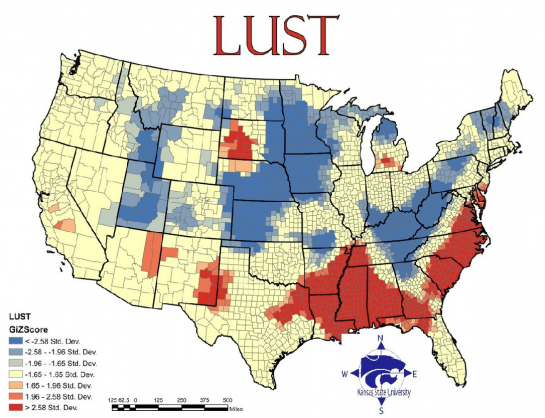
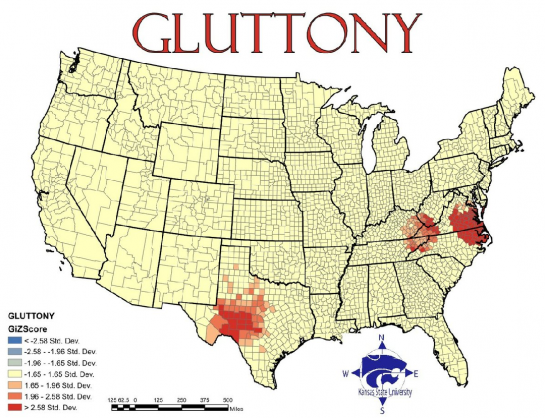
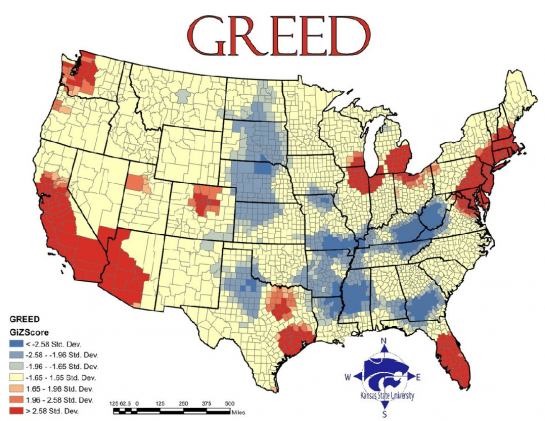
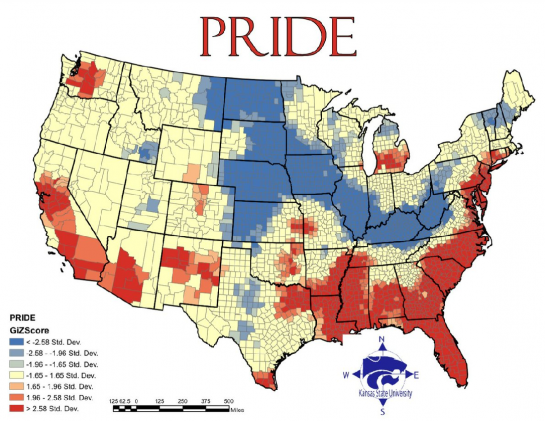
Theoretically interesting, but sketchy in its execution: geographers from Kansas State University create visual maps of the prevalence of the seven deadly sins across the U.S. using various statistics as a (tenuous) proxy for the country's sinfulness.


Lust: based on the incidence of sexually transmitted diseases. Because lusty people have unsafe sex and spread disease. Research courtesy of the Bible Belt!


Gluttony: based on the number of fast food restaurants per capita... While I definitely get the correlation between gluttony and fast food (big, cheap and FAST!), perhaps an obesity map would have worked better? All this shows to me is the homogeneity with which fast food franchises have colonized the country.


Greed: reflects average incomes versus total inhabitants below the poverty line... This one I believe is flawed. I can't think of a way of combining these two statistics to come up with a measure that would at all correlate to or even connote greed. The map too seems to indicate that they are simply equating greed with prosperity.


Sloth: reflects spending on arts, entertainment and recreation versus rate of employment... A bit uninspired, and ideologically flawed, but okay.


Wrath: reflects total violent crimes per capita. Sounds about right!


Envy: based on the total number of thefts... Seriously? San Francisco guiltier of envy than LA???


Pride: calculated as the average of the six other sins... because pride is the origin of all sins? Cop out.


So... I take it Heaven is full of mid-westerners.

Via Flowing Data and Revolutions.

Monday, April 13, 2009

Trauma and the spotless mind


Seems like selective memory deletion is really the hot topic of debate nowadays, and obviously I am fascinated. This recent article, on Wired Magazine, touches upon the possibility of using memory editing drugs to treat post-traumatic stress disorders (PTSD) in soldiers.

The moral and ethical issues related to memory-editing drugs of course are numerous, and I've touched on a few of them before. My question here is a more practical/functional one...

On a very simplistic level, the case for using memory deletion to treat PTSD is that absent the negative memories from which they originate, the stress symptoms will subside. However, I wonder if there are cases in which knowing and dealing with the source of one's anxiety might in fact be the best way to cure it... Exposure therapy, for example, has proven fairly effective in treating PTSD.

Consider also this article in Scientific American, which suggests that PTSD is over-diagnosed among soldiers, when depression or social and reintegration problems might be equally to blame. In these situations it's hard to imagine that memory editing could possibly be a solution.

Nothing but flowers

At New York's Nyehouse gallery, Alexis Rockman's exhibit depicts an eerie, post-apocalyptic world dominated by plants and animals -- beautiful, but strange, like three-eared rabbits and conjoined daisies.

According to Rockman:
“In my mind, that had to do with mutation and pesticides... The idea of the perfect lawn.”


Check out the slide show and commentary on Seed Magazine.

Monday, March 30, 2009

Adventures in selection bias


I always love a naughty research study, and this one sounded like fun: Spanking 'brings couples together'...

Researchers at Northern Illinois University measured stress hormone levels in couples engaging in S&M activities, and found evidence that these activities, while causing some anxiety at first (which, I suppose is the point, right?) ultimately left the couples feeling closer.

And what was their research sample? People attending an S&M party.
Yes. Really.

So... S&M brings couples who are into S&M closer? You don't say!