Wednesday, August 19, 2009

Visualizing your online persona

Ever been curious about your online identity? Or, more specifically, how a computer algorithm with all its inherent limitations might perceive your online identity?

Enter Personas, a project by the Social Media Group from the MIT Media Lab:
"[Personas] uses sophisticated natural language processing and the Internet to create a data portrait of one's aggregated online identity. In short, Personas shows you how the Internet sees you.

"Enter your name, and Personas scours the web for information and attempts to characterize the person - to fit them to a predetermined set of categories that an algorithmic process created from a massive corpus of data. The computational process is visualized with each stage of the analysis, finally resulting in the presentation of a seemingly authoritative personal profile."

Okay, so this doesn't work for me because I am a virtual unknown with no online identity to speak of. I am an Internet Nobody, sad but true.

But I tested this out instead with one of my favorite Internet Somebodies: Richard Feynman (full disclosure: he was my longest lasting imaginary crush through high school). The results are quite funny...


Click the image to enlarge (sorry for the low res).

I have to say, I would never guess this was the online persona for a Nobel Prize winning physicist... The big sports component (yellow on the left) is to me most amusing. Run the algorithm and you'll see that it's due to a misinterpretation of the words "series" (in this case "lecture series" not sports series) and "player" (from the oft-reported fact that Feynman was a "bongo player" - really).

Of course, the smart kids at MIT were aware of this all along:
"Personas demonstrates the computer's uncanny insights and its inadvertent errors, such as the mischaracterizations caused by the inability to separate data from multiple owners of the same name. It is meant for the viewer to reflect on our current and future world, where digital histories are as important if not more important than oral histories, and computational methods of condensing our digital traces are opaque and socially ignorant."

Nifty stuff.

Tuesday, August 18, 2009

Rorschach paintings: From ink to art

Vesna Jovanovic is perhaps not your typical artist, and her works are most certainly not typical. Once an arts and chemistry double-major, she now draws inspiration for her paintings from nature, science and psychology.

Her most recent works? A series called "Pareidolia," in which she starts with a random ink spill, and then fills in the silhouette with meticulous drawings ranging from the organic to the mechanical: veins and neurons interlaced with glass-work and electronic wiring.


The title itself is genius:
"I eventually titled the series Pareidolia, a term used to describe the psychological phenomenon of recognizing specific, identifiable forms in otherwise random stimuli. Common examples of pareidolia are the recognition of animals in clouds or faces in wood grain, and it is the basis of the Rorschach test, the series of inkblots used by psychologists to gain insight into a patient’s mental state."

Indeed, the creative process itself works like an applied Rorschach test, turning an inkblot and its connotations for the artist into a work art.

Check out Jovanovic's portfolio here.
Via Seed Magazine.

Monday, August 17, 2009

EveryBlock: News visualization goes local

So... back to one of my favorite topics: visualizing news.

As I've mentioned a few times before, innovations so far in the space have been quite lacking. Often big and flashy, but of scant use to someone actually out looking to catch up on some news.

So here's a welcome change: EveryBlock is a hyper-local news site with a simple layout and visualization tools that look like they might actually come in handy.


It offers neighborhood-specific news feeds, a simple news map, and city stats such as police calls, liquor license status changes, and restaurant inspections. It's also available as an iPhone app, which I'll be sure to check out.

It's definitely a good start and I like that their focus is clearly on utility.

Not surprising therefore that it was recently sold to MSNBC, which is at least trying to come up with some creative solutions to revitalize the online news space. Check out their Spectra Visual Newsreader while you're at it. I still think it falls into the category of More Flashy Than Useful, but at least it's a step in a different direction.

Curious to see how EveryBlock will fit in.

Monday, August 3, 2009

Order in randomness

Random Walk asks a curious question: What does randomness look like?

Through a collection of beautiful visualizations, it reveals the strange interplay between chaos and order within seemingly random phenomena, like rice grains falling, or the digits in the number Pi.

The latter in particular I find really interesting. Plotted as a random walk, where the value of each decimal determines the direction of a fixed-length step, Pi traces a path evocative of a fractal.


Definitely worth checking out.

Wednesday, July 29, 2009

Truth

"As mathematicians, we play and dream but we don't cheat. You can't cheat in mathematics. Truth is so important. To solve a problem with a proof is exciting and rewarding because it is true forever." ~Marie-France Vigneras

I miss that about my days studying math... Nothing to spin.

Via Seed Magazine.
Their whole slide show on photographs of mathematicians is worth checking out.

Thursday, July 23, 2009

Why cheap airlines are cheap

As someone who grew up in Europe with the luxury of an EasyJet flight from Milan to London for under 50 Euros, the exorbitant prices of U.S. airlines (even the so-called cheap ones) are a constant source of bafflement and frustration.

In case you've wondered how certain airlines can profitably keep prices their prices so low, this visual makes it very clear.


And true, many of the cost reductions come from doing more of what we all hate about airlines: cramming more seats and offering less perks. But piling into an overcrowded tin cylinder without so much as a bag of peanuts to distract me from the crying baby two rows back wouldn't be half so bad if it didn't come with a $500 price tag.

I am all about no frills flights, just as long as they're actually cheap.

Oh, and to American Airlines who insists on recycling its blankets until they are so sticky and strewn with hair that I am afraid of touching them: enough with that already. Just get rid of them. Half-assed perks are far worse than no perks at all.

Via flowingdata, which I am clearly obsessed with.

Self-tracking through Twitter

Data data data. Especially, our own.

From Nike shoes that allow you to log your miles on an iPhone app, to that kid on Twitter who feels compelled to tell the world how many laps he swam each morning, self-monitoring seems to be the latest fad. I track, therefore I am.

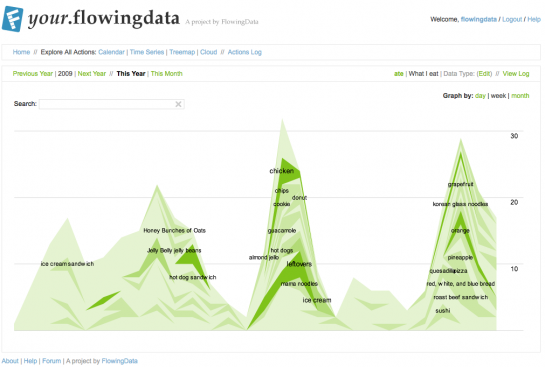
And while there is no shortage of tools available to our inner OCD, one in particular stands out in my mind: your.flowingdata.

Created by UCLA PhD candidate Nathan Yau as part of his thesis on self-surveillance, your.flowingdata allows users to aggregate personal data through daily tweets, and then visualize it in various different formats, including graphs, treemaps and word clouds.


Obviously, as a closet obsessive-compulsive and data visualization fan, I am more than a little intrigued so I've started tracking one simple aspect of my life: my moods and their intensity during the workday (since that's when I'm mostly on Twitter).

Yes, I realize I have picked perhaps the least objective metric possible, but that's half the fun. I'm curious as much about my moods as to what might affect my perception of and decision to report on them.

More updates on that to come.

In the meantime, you can read more about your.flowingdata here.
Also, here's an older post on visualizing music consumption, another cool thing to track.

Tuesday, June 16, 2009

Art from paper

Simon Schubert makes art simply by folding paper, and the results almost unbelievable.


It's amazing what a sheet of paper and a serious dose of imagination can create.

Check out this earlier post for some more paper-based inspiration.

Via today and tomorrow.

Saturday, June 6, 2009

Of money and morality


A little while ago I posted about site called YourMorals.org, which uses responses to various quizzes as data for research on moral psychology, and since then I've been taking a bunch of their tests.

This has afforded me such encouraging insights as: I am significantly less satisfied with my life than the average test-taker, I am more likely than average to react to things with disgust, my morality is essentially about avoiding harm and preserving freedom, and I take serious issue against authority and purity. Go figure.

But there's one test in particular that caused me to pause: the "Sacredness Survey".

It works like this:
You are presented with various hypothetical acts (burning your country's flag, pricking a child's hand...) that might violate notions you hold "sacred" and you are asked what it would take for you to engage in these acts. Your response options are the following:
  • $0 (I'd do it for free)
  • $10
  • $100
  • $1,000
  • $10,000
  • $100,000
  • A million dollars
  • Never for any amount of money

So, at risk of revealing myself as the freak that I am, here were my results -- and it should be noted that this applies only to the acts that I said I would do: it excludes things I wouldn't do for any sum of money.
  • It would take an average of $0 to get you to violate the HARM foundation.
  • It would take an average of $5000 to get you to violate the FAIRNESS foundation.
  • It would take an average of $33333.333333333 to get you to violate the INGROUP foundation.
  • It would take an average of $0 to get you to violate the AUTHORITY foundation.
  • It would take an average of $0 to get you to violate the PURITY foundation.

Creepy right? I sound like a cheap psychopath.

But this is where I think the study is flawed, or at least very ill-suited to my personal brand of morality...

When it comes to morality and "sacredness", if there's something that doesn't bother me, then I need no financial compensation to do it. In fact, I will gladly break a taboo just for laughs.

One that tickled me from the survey: Sign a piece of paper that says "I hereby sell my soul, after my death, to whoever has this piece of paper." Sure, I'll do that for free for the sheer irony of it.

However, when it comes to things I won't do, like pricking a child's hand (back to my harm-based personal morality), then typically no amount of money will convince me to do it, not because I'm so honest I can't be bought, but because getting paid for doing something bad makes it worse, not better. I may regret harming a child, but getting paid to harm a child is something I might never be able to live down. And the greater the fee the more immoral the act.

Who knows... I guess it's my relationship with money that's coming into play. I have no problem getting paid for work done or services rendered (heck, I have a job after all!), but getting paid to do something bad is a whole other story. So basically, I think my personal financial hang-ups are creating "noise" in my responses to that survey, confusing the results.

I my mind, the major flaw with this survey is that is assumes a commensurability between money and morality, as if the costs of one could be compensated by the benefits of the other. However, money itself has huge moral connotations for most people and it's wrong to think one could introduce that into the equation without fundamentally changing the game.

Tuesday, June 2, 2009

Quizzes for a cause

Ever been curious about the fundamental underpinnings of your personal moral code? Or how you stack up against others in the moral spectrum? Or how morality affects your daily behaviors?

Take the quizzes offered on YourMorals.org and your answers will be added to the body of knowledge informing current research on moral psychology.

Plus, the tests are wonderfully addictive.